
The Timmaron leadership team is currently doing a regional tour of Asia, including meeting with key partners in South Korea, Taiwan, Vietnam, Singapore, and India. Timmaron CEO Barb Stinnett provided this Day One report:
Our first stop was Seoul. As part of Timmaron Group’s Asia Strategic Mission, we were fortunate to meet with Hyoung-Rock Kim, PhD, of LG Electronics to explore the convergence of artificial intelligence, humanoid robotics, embodied AI, and their potential application to healthcare, independent living, and community-based care. Dr. Kim is highly respected and known in the industry as a global leader in his field. The meeting was particularly significant because his work sits directly at the intersection of several areas central to Timmaron Group’s strategy: AI that can perceive and understand the physical world, intelligent robotics, human-machine interaction, and the translation of advanced research into practical applications that improve people’s lives.
LG Electronics is one of South Korea’s largest and most globally recognized technology companies. While historically known for consumer electronics and home appliances, LG is transforming itself into what it describes as a “Smart Life Solution Company.” That transformation increasingly encompasses artificial intelligence, robotics, smart homes, mobility, advanced manufacturing, commercial systems, and intelligent environments.
For Timmaron Group, LG is a strategic global partner — particularly interesting because the company possesses the ability to connect several technology layers that are frequently developed independently. Those being Artificial Intelligence, Sensors, Robotics, Devices, Smart Environments, Manufacturing, and Global Deployment That combination creates the potential to move AI beyond software and into the physical environments where people actually live, work, and receive care, which at the core if our work at Timmaron Group.
Dr. Hyoung-Rock Kim is a Research Fellow at LG Electronics focused in humanoid and embodied AI
His professional background is particularly relevant to the future direction of LG and to Timmaron Group’s interests. We were honored to meet with him and discuss our collaboration in healthcare, industrial manufacturing, and technologies. Some learnings from our visit follow:
Humanoid Robots are designed to operate in environments originally created for humans rather than requiring the environment to be redesigned around machines. This is particularly important for homes and healthcare.
Embodied AI represents an important evolution of artificial intelligence. Rather than an AI system simply processing information on a computer, embodied AI enables an intelligent physical system to perceive its environment, reason about what is happening, make decisions, and physically interact with the world.
For Timmaron Group and our clients, this distinction is critical. For patients and providers, this is game-changing, as it starts to consolidate the overwhelming amounts of data we all have to provide and receive and puts it into understandable, actionable information! We also have hope it will reduce IT costs, the more we move to apply these technologies and refresh organizations’ IT approach to solving problems in healthcare.
Let’s be clear. Timmaron’s mission is not to develop technology simply because it is technologically possible. We focus on applied technology — identifying how AI and emerging technologies can be translated into solutions that improve quality of life and expand access to healthcare.
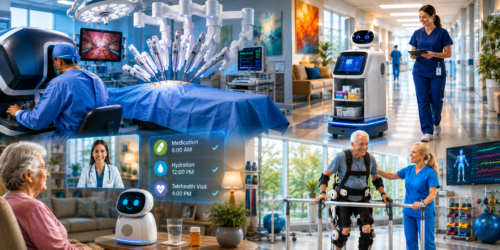
From Embodied AI to Embodied Healthcare. One of the most significant opportunities discussed was the possibility of taking embodied AI technologies being developed for humanoid and service robotics and applying them to healthcare. Consider an intelligent robotic system operating inside someone’s home. It could potentially learn the environment, understand normal patterns of daily activity, navigate safely around furniture and people, recognize objects, respond to spoken requests, and eventually perform useful physical tasks. Add healthcare intelligence to that capability and the opportunity becomes substantially larger.
The robot or intelligent home environment could potentially assist with:
- Medication reminders and adherence
- Mobility and fall-risk monitoring
- Nutrition and hydration
- Retrieval of household or healthcare items
- Connection with family and caregivers
- Telehealth interactions
- Monitoring changes in normal behavior
- Assistance with activities of daily living
- Social interaction and companionship
- Emergency identification and escalation
This represents a natural intersection between LG’s embodied AI and robotics expertise and Timmaron’s healthcare and applied-technology expertise.
LG + Timmaron Vision
Our combined strategic opportunity is larger than developing a robot. Timmaron Group creates cutting-edge, intelligent healthcare environments around the individual. LG already has technologies throughout the home — appliances, displays, sensors, communications technology, smart-home systems, and increasingly robotics and AI. Together as global partners, we will bring the future of “connected care” and level the playing field for all.
Dr, Hyoung-Rock Kim and LG’s robotics organization are developing intelligence capable of understanding and interacting with the physical world. Timmaron brings the critical thinking layer. Our thinking and experience includes understanding patients, providers, medical-device companies, healthcare workflows, community health, regulatory considerations, and the commercialization pathways required to transform emerging technologies into deployable healthcare solutions.
The solution in the Timmaron Group creates with LG as part of our Healthcare offerings could break down as follows:
An AI-Enabled Independent Living Platform
This platform would integrate LG Smart Home + Sensors + Embodied AI + Humanoid/Service Robotics + Healthcare Intelligence + Caregiver Connectivity. With our passion and purpose, this offering is clear. It would help people remain healthier, safer, and independent in their own homes for longer.
Why This Matters for Community Healthcare
The implications extend beyond affluent consumers adopting sophisticated household robots. Timmaron Group is working with our clients to address healthcare workforce shortages and improve access to care in communities where resources are limited. Rural communities and other underserved populations almost always face shortages of clinicians, caregivers, and healthcare infrastructure.
We understand technology cannot replace the human relationship in healthcare. It can, however, extend the reach of those humans. A healthcare professional who cannot physically visit every patient could potentially remain connected through intelligent technology located within the patient’s environment. That changes the fundamental healthcare model from “patient travels to healthcare” to “Healthcare intelligence travels to the patient.”
That alone won’t solve our healthcare crisis, but is a great step to continuing the journey to be more people-centric, by applying technologies! For more about our healthcare mission, please reach out to us via hi@timmarongroup.com.