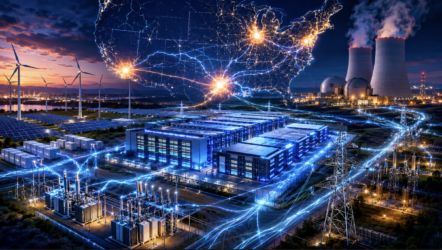

The conversation around America’s power grid has fundamentally shifted. For more than a decade, U.S. electricity consumption remained remarkably flat, kept in check by steady gains in energy efficiency and such things as LED lighting adoption and distributed solar power. However, the explosive rise of generative artificial intelligence and high-density cloud computing has triggered a sudden, unprecedented surge in electricity demand, putting immense strain on regional utilities and redrawing the national energy map.
The Reality of the Data Center Demand Surge
Historically, data centers were selected for their proximity to major fiber-optic networks and population hubs. Today, site selection is driven by a single, critical metric: the physical availability of megawatts.
The scale of this energy appetite is staggering. A single AI-related query or training task can consume up to 1,000 times more electricity than a traditional web search. While a conventional data center might draw power equivalent to a few thousand homes, next-generation AI campuses currently under construction are scaling toward gigawatt-level requirements – capable of rivaling the energy footprint of major cities.
According to industry forecasts, U.S. data center power demand is on track to more than double within a short timeframe, climbing from 31 gigawatts (GW) in 2025 to a projected 66 GW by 2027. This rapid expansion is expected to elevate data centers’ share of total U.S. peak summer power demand from roughly 4% to an alarming 8.5% by 2027.
Mapping the New National “Hotspots”
This demand is not distributed evenly, creating localized pressure points where data center clusters are pushing regional infrastructure to its absolute operational limits.
• PJM Interconnection (Mid-Atlantic): Anchored by Loudoun County, Virginia – the data center capital of the world – this region is a critical hotspot. The concentration of digital infrastructure here has created immense transmission bottlenecks and strict utility capacity allocation rules.
• ERCOT (Texas): Already vulnerable to extreme weather anomalies, the Texas grid faces massive new large-load interconnection requests. While Texas is aggressively adding power generation, the sheer volume of simultaneous data center applications strains transmission planning.
• The Midwest and Southwest: Tech giants are increasingly looking toward states like Ohio, Iowa, and Arizona, chasing available land and any remaining pockets of unallocated power grid capacity.
In severe cases, the imbalance between real-world grid capacity and sudden load spikes has manifested as localized micro-disruptions. Some regions are experiencing localized rolling blackouts or emergency grid protocols during peak hours – a reality that is prompting even residential users in some areas to invest in backup generators to secure personal infrastructure continuity.
The Utility Paradox: Renewable Goals vs. Fossil Realities
The race for power has created a profound paradox for what many saw as the transition to clean energy. The world’s largest technology companies have strict corporate mandates to achieve net-zero carbon emissions. On one hand, their massive capital investments are hyper-accelerating the commercial solar, wind, and battery storage markets. On the other hand, data centers require “clean, firm power” – meaning electricity must be fully available 24/7/365, regardless of whether the sun is shining or the wind is blowing. Because utility-scale energy storage cannot yet fully bridge the intermittent gaps of renewables over extended periods, utilities are facing a difficult choice:
The Infrastructure Trade-Off: To prevent grid destabilization from massive new data center loads, multiple U.S. utilities are actively delaying the retirement of aging coal operations and aggressively constructing new natural gas peaker plants.
Consequently, the immediate rush to feed the AI boom is actively risking an emissions “lock-in” that directly conflicts with long-term reduced carbon-emission targets.
Supply Chain Chokepoints: “Speed to Power”
The final primary bottleneck is no longer just generating the electricity, but physically moving it. The sheer velocity of data center construction has completely overwhelmed the electrical equipment manufacturing supply chain.
Critical equipment lead times have dramatically lengthened since 2020-21. For example, Generator Step-Up Transformers had a lead time of 52 weeks then, but the current lead time is 3+ years. High-Voltage Circuit Breakers had a lead time of 77 weeks in 2020-21, but the lead time is now 125+ weeks.
To navigate these multi-year delays, major utilities and wealthy data center developers are being forced to alter procurement strategies entirely. Organizations are ordering critical grid components up to five years in advance, paying massive upfront premiums to secure manufacturing slots, and even turning to behind-the-meter, on-site natural gas or fuel-cell generation to bypass the grid queue altogether.
A Shift Is Happening
To resolve the utility paradox and bridge the gap between aggressive decarbonization goals and the absolute need for 24/7 reliability, the technology sector has ignited a massive renaissance in nuclear energy.
Because data centers cannot rely solely on the intermittent nature of wind and solar, tech giants are increasingly viewing nuclear power as the ultimate “clean, firm” energy source. This shift is happening across two distinct fronts:
1) Restarting Retired Reactors: To secure immediate baseload power, hyperscalers are entering unprecedented long-term power purchase agreements (PPAs) tied to existing nuclear infrastructure. A prime example includes utilities actively working to reopen mothballed traditional facilities – such as Pennsylvania’s Three Mile Island – solely to funnel dedicated zero-emission electricity to proprietary tech grids.
2) The SMR and Microreactor Pipeline: Beyond legacy plants, developers are bypassing the clogged public grid queue by investing in Small Modular Reactors (SMRs) and advanced microreactors to achieve “behind-the-meter” self-supply. Companies such as Amazon, Google, and Microsoft have anchored billions in financing and conditional offtake stakes with nuclear innovators like X-energy, Kairos Power, and TerraPower. These compact, factory-fabricated reactors are designed to sit directly alongside data center campuses, offering gigawatt-scale density with a fraction of the physical footprint of traditional plants. While broad commercial deployment of SMRs faces strict multi-year Nuclear Regulatory Commission (NRC) licensing hurdles and domestic fuel supply chain bottlenecks, tech capital has effectively fast-tracked nuclear from a legacy alternative to the cornerstone of future digital infrastructure planning.
To discuss more about how data centers are transforming the U.S. energy landscape, start by emailing us at hi@timmarongroup.com.