
The idea of putting data centers into orbit has moved rapidly from science fiction to serious industry discussion. With companies like Google, SpaceX, and startups such as Starcloud exploring orbital infrastructure, the concept is now grounded in real engineering and economic debates. But, as with any frontier technology, the opportunity comes with significant tradeoffs.
Let’s look at the major benefits:
- Virtually Unlimited Energy (and Lower Costs) – One of the strongest arguments comes from energy economics. As Amir Husain writes in “Why Your Next Cloud Server Will Orbit Earth,” space-based data centers could leverage continuous solar power, free from night cycles or atmospheric loss. Similarly, NVIDIA-backed startup projections suggest up to 10x lower energy costs due to constant solar exposure and elimination of terrestrial constraints.
- Natural Cooling and Environmental Benefits – Cooling is one of the largest costs for terrestrial data centers. In space, excess heat can be radiated directly into the vacuum, avoiding water usage and reducing environmental strain. This fact also sidesteps growing community resistance to large, power-hungry data centers on Earth.
- No Land Constraints or Zoning Issues – Orbital infrastructure eliminates real estate constraints entirely. Data centers could scale far beyond what’s feasible on Earth without competing for land or facing regulatory friction.
- A New “Edge” for Space-Based Workloads – Experts at Enterprise Strategy Group note that space data centers could act as edge compute platforms for satellites, processing data in orbit instead of sending everything back to Earth. That would make space data centers particularly valuable for earth observation, defense systems, and autonomous space operations. In these use cases, space compute actually reduces latency (more on that below).
Now for the major drawbacks:
- Massive Cost and Operational Complexity – Launch costs remain a fundamental barrier. Even with falling costs from reusable rockets (hello, SpaceX), deploying and maintaining hardware in orbit is still orders of magnitude more expensive than terrestrial infrastructure. As telecom analyst Armand Musey has noted, the economics are still “hard to model” due to unknown technical variables.
- Maintenance Is a Nightmare – Unlike Earth-based data centers, you can’t just swap a failed server. Hardware must survive radiation, micrometeoroids, and extreme temperature swings. Repairs would require robotic servicing or additional launches. That’s one reason skeptics argue the concept may be impractical in the near term.
- Latency: The Core Challenge – Here’s the biggest issue for Earth-based applications. Signals must travel from Earth to orbit and back. That distance introduces delay, because geostationary orbit can produce hundreds of milliseconds of latency. Even mid-orbit systems may see ~50–150 ms latency. Compared to fiber, where latency is extremely low, this is a major disadvantage for real-time AI inference, financial trading, and interactive applications, for example.
The big question: how can the latency problem be addressed?
This is where the topic gets interesting, and more nuanced:
- Move to Low Earth Orbit (LEO) – Instead of placing data centers far away (GEO), using LEO (~500–600 km) reduces latency dramatically: only ~2–4 ms one-way propagation delay. That begins to approach terrestrial network performance for certain use cases.
- Optical (Laser) Inter-Satellite Networks – Modern designs rely on laser-based communication links between satellites, allowing data to move through space without touching the ground. In some scenarios, this could even outperform fiber, due to straighter paths, fewer routing hops, and ultra-high bandwidth (multi-terabit potential),
- Hybrid Space–Earth Architectures – The most realistic near-term model is hybrid infrastructure, meaning latency-sensitive workloads stay on Earth, while batch AI training or space-native workloads run in orbit. That is, terrestrial networks still provide ultra-low latency where needed, while space handles energy-intensive compute.
- Edge Computing in Space – For satellite-heavy industries, space data centers actually reduce latency by processing data locally before transmission. Which paints an interesting picture: latency is a problem for Earth users, but a solution for space systems.
The bottom line.
Space-based data centers are not a replacement for terrestrial infrastructure – at least not yet. But they are a compelling extension of it. The best fit for the near term would be space-native workloads, AI training, and energy-intensive compute. The biggest hurdle is latency for Earth-based applications. The key use case now would seem to be LEO constellations + laser networking + hybrid architectures.
The most important insight is this: space data centers are not about better compute. Rather, they’re about cheaper energy. That’s certainly the position of SpaceX’s Elon Musk, who said on a recent podcast: “In 36 months, the cheapest place to put AI will be space.” He maintains that the real bottleneck in AI isn’t chips – it’s energy.
On the same podcast, Musk put it this way: “The availability of energy is the issue. If you look at electrical output, it’s more or less flat [outside of China, he noted]… Where are you going to get your electricity? Especially as you scale….how are you going to turn the chips on?” He went on: “It’s harder to scale on the ground than it is to scale in space. You’re also going to get about five times the effectiveness of solar panels in space versus the ground, and you don’t need batteries.”
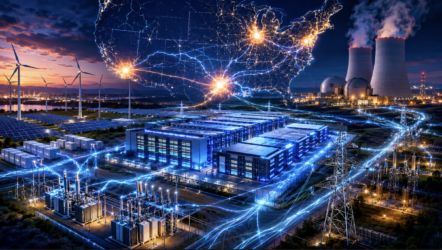
So, in closing, think about this: For the past two years, the AI conversation has centered on models, chips, and algorithms. The industry has debated transformer architectures, GPU shortages, and the competitive positioning of hyperscalers. But, beneath all of that is a more fundamental constraint – one that may ultimately define the winners and losers of the AI era – and that constraint is, quite simply, energy. As AI systems scale, the industry is colliding with a simple physical reality: compute requires power. And not just incremental power, but exponential increases in energy demand driven by training ever-larger models and running inference at global scale.
This shift reframes how we should think about AI infrastructure. The limiting factor is no longer just access to advanced semiconductors. It’s access to cheap, abundant, and reliable electricity. And, if the AI era is ultimately constrained by power, not chips, then orbit may become less of a novelty and more of a necessity.
Timmaron Group would welcome a discussion if you are, or expect to be, involved in the space data center industry. We have experience working with Starlink, a business unit of SpaceX, as a solution architect leading up to the launch of its first constellation of satellites in 2019. Reach out to us at hi@timmarongroup.com.