There’s been no shortage of media coverage lately about the infrastructure required to power the AI boom. Some positive, some not so much (which we’ll get to below).
In a recent blog post, we talked (in an upbeat way) about the prospects for data centers in space. That might be a ways off yet (we did cover the cons), but both Elon Musk and Sundar Pichai, CEO of Alphabet/Google, think orbital data centers could be a reality by next year – at least for certain applications. We won’t repeat what we said in that post. Go read it.
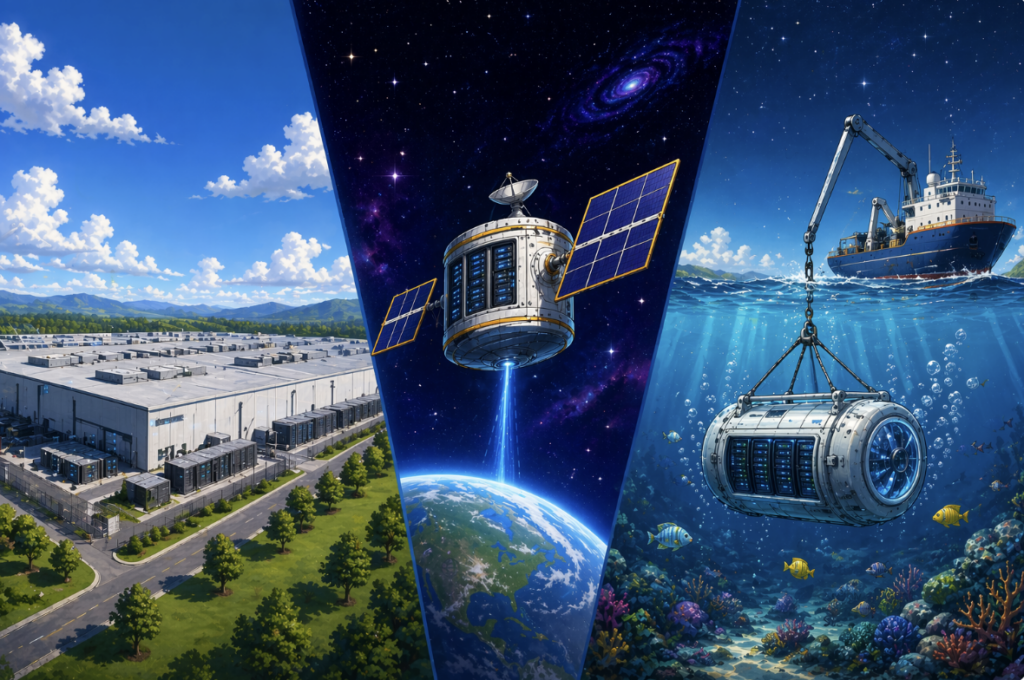
But space is not the only realm where data centers might be located in the future. Another new frontier is below the surface of the ocean. Actually, it’s not such a new idea. Microsoft began experimenting with this approach in 2015. (That project is no longer active.) Marine or underwater data centers are one of the more intriguing experiments in next-generation infrastructure. The basic idea is simple: instead of building massive server farms on land, companies place sealed server modules on the ocean floor or in offshore floating structures, using cold seawater as a natural cooling system. But it is still early-stage and experimental overall.
In more recent years, China has been making inroads, now pushing marine data centers further toward commercialization. A state-backed underwater data center project near Shanghai reportedly became operational in late 2025. It combines sealed underwater server capsules, offshore wind energy, and seawater cooling. Its developers plan to scale beyond what Microsoft did with its prototype deployments. Independent long-term validation is still limited.
With marine data centers, the biggest driver is energy efficiency. Traditional data centers consume enormous amounts of electricity, and a large share of that power goes toward cooling. Underwater systems use the naturally cold, stable temperature of seawater to dissipate heat, potentially reducing cooling energy dramatically. Roughly half the world’s population lives near coastlines. Offshore data centers could reduce latency by placing computing power closer to users. Also, there’s the potential benefit of faster deployment. Instead of years of land acquisition and construction, proponents envision factory-built pods that could simply and quickly be deployed offshore. However, the biggest issue is the difficulty of servicing these pods. That could be very costly.
But back to what we have today: “terrestrial” data centers. They are seemingly popping up everywhere, to meet the surging demand from consumers and businesses for AI, and the voracious needs of the so-called hyperscalers. The problem is that communities increasingly don’t want these massive buildings in their backyards. We’re hearing about vocal opposition all over the country. In Minnesota alone, as many as 10 communities have seen organized resistance, public controversy, or formal political fights over major data center projects. The best known right now are the proposed data center projects in Hermantown (near Duluth) and Becker (just north of the Twin Cities). In Iowa, as many as five communities have had visible public opposition or emerging debate so far. And the same is true in many other states.
What’s the answer? Well, space and marine data centers offer promising solutions to many of the issues of land-based centers. The next few years will undoubtedly see these alternative offerings being adopted. The continuing rise of AI will demand it.
Want to discuss this issue further? If so, reach out to us at hi@timmarongroup.com.